

Introduction
The UAE has long faced one pressing environmental challenge: water scarcity. With one of the driest climates on Earth, the country receives minimal annual rainfall, making water security a national priority. Over the past decade, the UAE has become a global leader in cloud seeding, a scientific method of enhancing natural precipitation.
In 2025, this mission has taken on new urgency. Warmer winters, more erratic weather patterns, and a growing population demand have pushed the country to refine and scale its operations. Today, advanced aircraft, AI-powered forecasting tools, and international research collaborations drive an ambitious rain enhancement programme designed to extract more water from passing clouds.
This article explores cloud seeding in the UAE in detail — its purpose, the science, the technology, its successes and criticisms, and the future vision for the programme. By the end, you’ll understand not just how it works but also why it matters for the UAE and beyond.
1. ✈️ What is the mission? — the UAE’s purpose and goals
The UAE’s cloud seeding mission is managed primarily by the National Centre of Meteorology (NCM). Its central goal is to boost rainfall over targeted regions when suitable clouds appear. Unlike myths of “creating storms from nothing,” this process relies on existing clouds that have the potential to produce rain but may not do so efficiently.
In 2025, the NCM has intensified its operations, aiming to counteract the effects of a drier-than-average winter and prolonged heat waves. The objectives are twofold:
- Enhance water security by increasing the natural recharge of aquifers.
- Reduce reliance on costly desalination, which consumes significant energy and impacts marine ecosystems.
By carefully planning and executing cloud seeding missions, the UAE hopes to achieve modest but meaningful increases in rainfall, enough to make a difference to agriculture, greenery projects, and long-term water storage.
2. 🧪 How it works — the science in simple terms
The principle behind cloud seeding is surprisingly straightforward. Clouds form when water vapour condenses onto tiny particles in the atmosphere, called condensation nuclei. In some cases, clouds contain enough moisture but lack sufficient particles for droplets to grow large enough to fall as rain.
Cloud seeding addresses this by introducing additional particles into the cloud. These are typically hygroscopic (water-attracting) salts, which provide more surfaces for water droplets to cling to. As the droplets grow and collide, they eventually become heavy enough to fall as rain.
The UAE primarily uses two techniques:
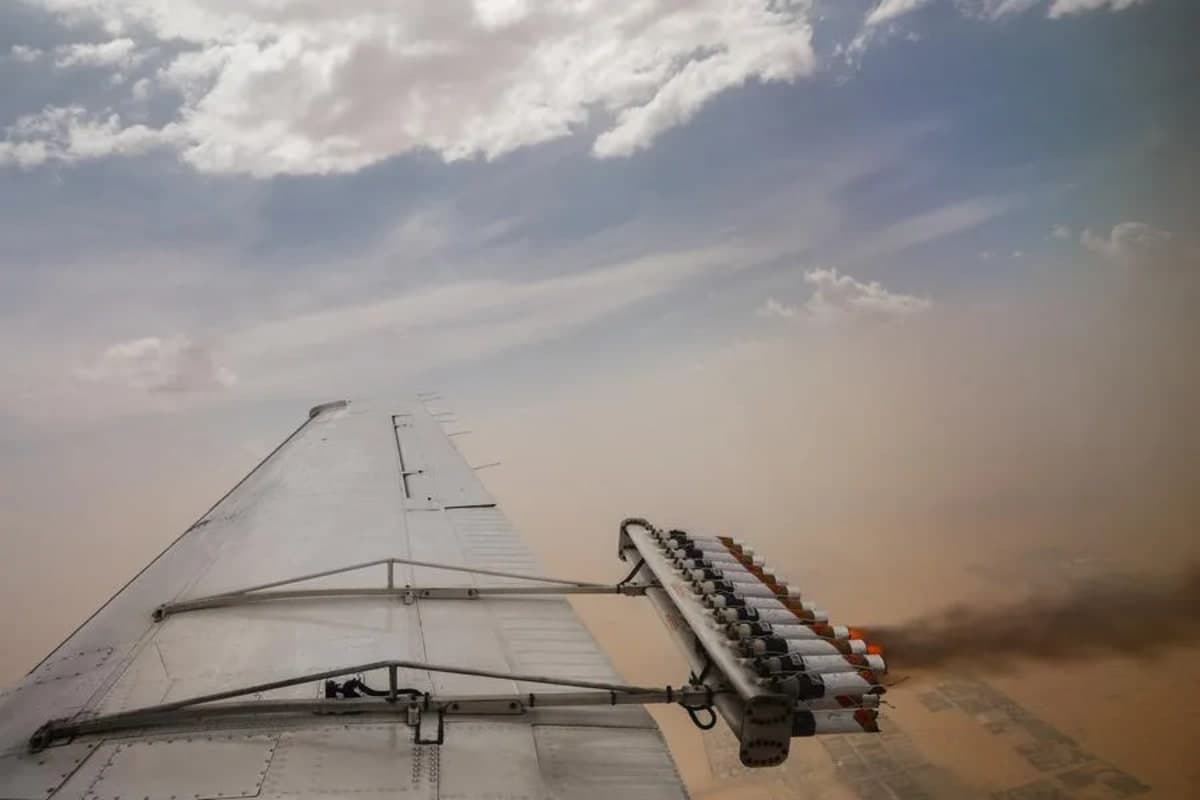
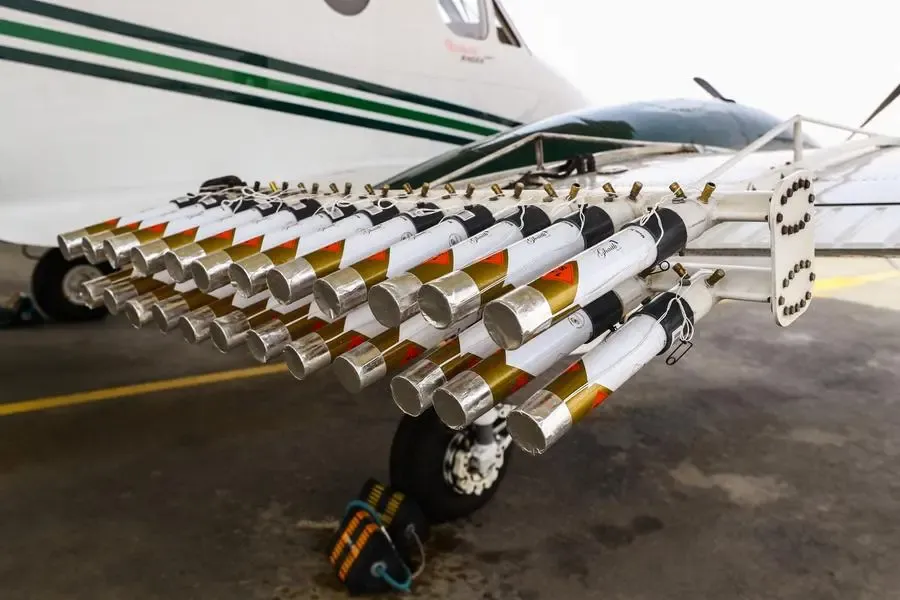
- Hygroscopic flares: Released from aircraft into warm clouds, these burn and disperse fine salt particles.
- Ground-based generators: Deployed at strategic points, releasing seeding material into updrafts that carry them into the clouds.
This process does not guarantee rainfall — it simply improves the odds when conditions are right.
3. 🛩️ Platforms and tools — planes, flares, drones, and AI
The operational heart of UAE cloud seeding lies in its specialised fleet of aircraft. Small twin-engine turboprops, fitted with wing-mounted flare dispensers, are deployed at short notice when meteorologists spot promising cloud formations.
Each mission involves a tightly coordinated team:
- Pilots are trained to fly precise patterns inside or alongside clouds.
- Onboard technicians who ignite and release flares at the right altitude.
- Meteorologists on the ground are tracking cloud development in real-time using Doppler radar and satellite feeds.
In recent years, the UAE has also tested drones for cloud seeding, allowing more targeted and lower-cost operations. Meanwhile, AI tools now analyse weather data from multiple sources, predicting not only where clouds will form but also which ones have the highest rain-making potential. This tech integration has significantly reduced wasted missions and increased the efficiency of operations.
4. 📊 Scale and activity in 2025 — more flights, more focus
By 2025, the UAE’s cloud seeding programme will have become more intensive than ever. The NCM operates on a “rapid deployment” model, meaning aircraft are ready to take off within minutes when favourable clouds are detected.
- Flight counts: The year has already seen hundreds of missions, far surpassing early programme numbers from a decade ago.
- Seasonal shifts: While winter remains the prime season, missions are increasingly launched in transitional months like March and October, as climate variability changes traditional rainfall patterns.
- Regional coverage: Seeding often targets the Hajar Mountains, as orographic lift helps clouds develop there, but operations also cover coastal and inland desert regions.
This scaling up reflects the urgency of meeting water needs and the confidence gained from previous years’ data.

5. 💸 Cost and logistics — what a program like this requires
Running a cloud seeding programme is resource-intensive. The biggest costs include:
- Aircraft operation: Fuel, maintenance, and crew salaries.
- Specialised equipment: Flare dispensers, radar systems, and weather modelling software.
- Seeding materials: Specially formulated salts that burn at high temperatures.
Estimates suggest each mission can cost thousands of dollars, depending on flight length and complexity. However, supporters argue the cost is small compared to the value of water produced and the potential savings from reduced desalination use.
6. 🔬 Effectiveness — what the data says so far
The million-dirham question is: Does cloud seeding work? Scientific reviews show mixed but generally positive results when conditions are ideal.
Controlled experiments in the UAE and abroad suggest that cloud seeding can increase rainfall by anywhere from 10% to 30% in seeded clouds. However, results vary widely depending on:
- Cloud type (warm convective clouds respond best)
- Humidity levels
- Wind patterns and updraft strength
In 2025, the NCM will be more transparent with data, publishing flight logs, rainfall measurements, and independent evaluations. While not every mission succeeds, the aggregated effect over a season shows measurable benefits.
7. 🌐 Research, collaboration, and the UAEREP initiative
To keep cloud seeding at the cutting edge, the UAE launched the UAE Research Program for Rain Enhancement Science (UAEREP). This global initiative funds research teams worldwide to develop new seeding materials, improve forecasting models, and test experimental delivery methods.
For example, recent UAEREP-funded projects have tested nanomaterials that can attract more water than traditional salts, as well as drones capable of delivering charges to stimulate droplet formation electrically. These partnerships not only improve the UAE’s capabilities but also contribute to global knowledge on weather modification.
8. ⚖️ Concerns and debates — environment, ethics, and equity
Like any weather modification method, cloud seeding is not without controversy. Environmental concerns include the potential accumulation of seeding materials in soil and water. The NCM counters this by noting that the materials used — primarily natural salts — are environmentally safe at operational concentrations.
Ethical debates arise over whether enhancing rainfall in one area could deprive neighbouring regions. Scientific consensus suggests that the effect is highly localised, but some remain cautious. There’s also the philosophical question: Should humans deliberately alter the weather, even in small ways? The UAE’s approach has been to balance action with careful monitoring and transparency.
9. 🧭 Real-world outcomes — examples from recent seasons
In early 2025, after an unusually dry start to the year, cloud seeding missions were credited with several significant rainfall events over the Hajar Mountains and interior regions. Farmers in certain valleys reported better-than-expected groundwater recharge, and some desert restoration sites saw a welcome boost in plant growth.
However, the link between these results and cloud seeding remains under scientific review, as natural storm variability can produce similar outcomes. This is why the UAE continues to invest heavily in controlled studies to separate signal from noise.

10. 🔮 What’s next — drones, models, and policy direction
Looking forward, the UAE’s cloud seeding programme will likely see:
- Greater use of autonomous drones for precision delivery.
- Integration of real-time AI weather modelling to identify seeding windows down to the minute.
- Development of eco-friendly seeding agents with even lower environmental footprints.
Policy efforts will focus on international collaboration and the creation of global guidelines for responsible weather modification.
Conclusion
The UAE’s cloud seeding programme in 2025 represents a strategic, science-driven response to water scarcity. It’s a blend of tradition — using proven seeding methods — and innovation, with AI, drones, and advanced research shaping the next chapter.
While not a silver bullet, cloud seeding offers a valuable tool in the UAE’s broader water management strategy. Continued transparency, scientific rigor, and international cooperation will ensure that this approach remains both effective and responsible in the years ahead.